Other evils there are that may come; for Sauron is himself but a servant or emissary. Yet it is not our part to master all the tides of the world, but to do what is in us for the succour of those years wherein we are set, uprooting the evil in the fields that we know, so that those who live after may have clean earth to till. What weather they shall have is not ours to rule."
-J. R. R. Tolkien, The Return of the King
Showing posts with label TOLKIEN. Show all posts
Showing posts with label TOLKIEN. Show all posts
Tuesday, May 20, 2025

Saturday, March 29, 2014
Feeling Thin
Why I feel all thin, sort of stretched, if you know what I mean: like butter that has been scraped over too much bread.
-J. R. R. Tolkien, The Fellowship of the Ring, 41.
-J. R. R. Tolkien, The Fellowship of the Ring, 41.
Sunday, May 6, 2012
A Dangerous Business
"[Bilbo] used often to say there was only one Road; that it was like a great river: its springs were at every doorstep, and every path was its tributary. 'It's a dangerous business, Frodo, going out of your door,' he used to say. 'You step into the Road, and if you don't keep your feet, there is no knowing where you might be swept off to. Do you realize that this is the very path that goes through Mirkwood, and that if you let it, it might take you to the Lonely Mountain or even further and to worse places?'"
-Tolkein, The Fellowship of the Ring, 72.
-Tolkein, The Fellowship of the Ring, 72.
Thursday, September 23, 2010
Monday, October 13, 2008
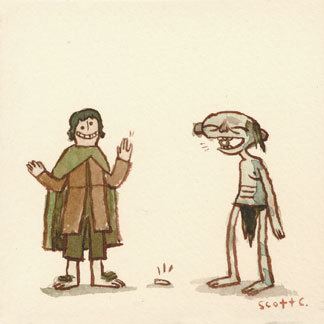
Mooreeffoc
And there is (especially for the humble) Mooreeffoc, or Chestertonian Fantasy. Mooreeffoc is a fantastic word, but it could be seen written up in every town in this land. It is Coffee-room, viewed from the inside through a glass door, as it was seen by Dickens on a dark London day; and it was used by Chesterton to denote the queerness of things that have become trite, when they are seen suddenly from a new angle.
-J. R. R. Tolkien, “On Fairy-stories,” A Tolkien Miscellany, 129-130.
-J. R. R. Tolkien, “On Fairy-stories,” A Tolkien Miscellany, 129-130.
Sunday, October 12, 2008
We Make Because We are Made
...To quote a brief passage from a letter I once wrote to a man who described myth and fairy-story as “lies”...
...Fantasy remains a human right: we make in our measure and in our derivative mode, because we are made: and not only made, but made in the image and likeness of a Maker.
-J. R. R. Tolkein, “On Fairy-stories,” A Tolkein Miscellany, 127.
“Dear Sir,” I said—“Although now long estranged,
Man is not wholly lost nor wholly changed.
Dis-graced he may be, yet is not de-throned,
and keeps the rags of lordship once he owned:
Man, Sub-creator, the refracted Light
through whom is splintered from a single White
to many hues, and endlessly combined
in living shapes that move from mind to mind.
Though all the crannies of the world we filled
with Elves and Goblins, though we dared to build
Gods and their houses out of dark and light,
and sowed the seed of dragons—’twas our right
(used or misued). That right has not decayed:
we make still by the law in which we’re made.”
Man is not wholly lost nor wholly changed.
Dis-graced he may be, yet is not de-throned,
and keeps the rags of lordship once he owned:
Man, Sub-creator, the refracted Light
through whom is splintered from a single White
to many hues, and endlessly combined
in living shapes that move from mind to mind.
Though all the crannies of the world we filled
with Elves and Goblins, though we dared to build
Gods and their houses out of dark and light,
and sowed the seed of dragons—’twas our right
(used or misued). That right has not decayed:
we make still by the law in which we’re made.”
...Fantasy remains a human right: we make in our measure and in our derivative mode, because we are made: and not only made, but made in the image and likeness of a Maker.
-J. R. R. Tolkein, “On Fairy-stories,” A Tolkein Miscellany, 127.
Saturday, July 12, 2008
Dipped in Story
The value of the myth is that it takes all the things we know and restores to them the rich significance which has been hidden by ‘the veil of familiarity’. The child enjoys his cold meat (otherwise dull to him) by pretending it is buffalo, just killed with his own bow and arrow. And the child is wise. The real meat comes back to him more savoury for having been dipped in a story; you might say that only then is it the real meat. If you are tired of the real landscape, look at it in a mirror. By putting bread, gold, horse, apple, or the very roads into a myth, we do not retreat from reality: we rediscover it. As long as the story lingers in our mind, the real things are more themselves. This book applies the treatment not only to bread or apple but to good and evil, to our endless perils, our anguish, and our joys. By dipping them in myth we see them more clearly.
-C. S. Lewis, “Tolkien’s The Lord of the Rings,” On Stories, 90.
-C. S. Lewis, “Tolkien’s The Lord of the Rings,” On Stories, 90.
Tuesday, October 2, 2007
What Sort of Tale
‘...And we shouldn't be here at all, if we'd known more about it before we started. But I suppose it's often that way. The brave things in the old tales and songs, Mr. Frodo: adventures, as I used to call them. I used to think that they were things the wonderful folks of the stories went out and looked for, because they wanted them, because they were exciting and life was a bit dull, a kind of a sport, as you might say. But that's not the way of it with the tales that really mattered, or the ones that stay in the mind. Folk seem to have been just landed in them, usually – their paths were laid that way, as you put it. But I expect they had lots of chances, like us, of turning back, only they didn't. And if they had, we shouldn't know, because they'd have been forgotten. We hear about those as just went on – and not all to a good end, mind you; at least not to what folk inside a story and not outside it call a good end. You know, coming home, and finding things all right, though not quite the same – like old Mr. Bilbo. But those aren't always the best tales to hear, though they may be the best tales to get landed in! I wonder what sort of tale we've fallen into?’
-J. R. R. Tolkein, The Two Towers, 696.
-J. R. R. Tolkein, The Two Towers, 696.
Friday, July 20, 2007
The Road Goes Ever On and On
The Road goes ever on and on
Down from the door where it began.
Now far ahead the Road has gone,
And I must follow, if I can,
Pursuing it with eager feet,
Until it joins some larger way
Where many paths and errands meet.
And whither then? I cannot say.
-J. R. R. Tolkein, The Fellowship of the Ring
Down from the door where it began.
Now far ahead the Road has gone,
And I must follow, if I can,
Pursuing it with eager feet,
Until it joins some larger way
Where many paths and errands meet.
And whither then? I cannot say.
-J. R. R. Tolkein, The Fellowship of the Ring
Subscribe to:
Posts (Atom)